Friday, March 4, 2016

The Deadpool Movie is Exactly what it Should Be!

Hi, I’m Daniel and it’s been 2 weeks since I’ve seen the Deadpool Movie.

In my defense, I saw it three times opening week, and I have come to the conclusion that I absolutely loved the movie.  I have yet to read or hear a legitimate complaint about the movie.  I have some personal issues, the humor was a bit too crude at some points for my taste and there was some nudity that felt a little excessive, but those are personal complaints not legitimate issues with the film itself.  And yeah there are spoilers ahead.  But if you’re reading a movie review this late after the film has come out and you get upset by that then I’m pretty sure you’re just broken inside. 

It amazes me that people are complaining about this film at all.  There’s nothing to complain about really.  So let’s look at some of these.  First up, they weren’t true to the origin.  Okay, I’ll give you that, they tweaked the origin a bit.  They had to so that it could fit into the X-Men Film Universe.  For the most part if you have an issue with that you basically have an issue with Brian Singer’s universe.  A universe I personally think he has screwed up royally since X2 (and seriously why do you hate color in costumes dude).  But the nods they gave us in the origin were spot on, they demonstrated that they did their homework and they did it well. 

Sure, Ajax is both Francis and Killebrew.  Without having both around basically we have assured that the sequel won’t just be another quest for revenge and will actually push the character in new directions, hardly grounds to complain.  Related, in the film Deadpool wasn’t a part of Weapon X and didn’t get his powers grafted onto him from Wolverine.  Well, honestly we don’t know that this wasn’t connected to Weapon X.  And so he just has the same ability as Wolverine that was triggered rather than grafted.  That’s a valid adaptation, especially given that his origin when last done in conjunction with the hairy little Canucklehead is rock bottom for our protagonist.

They also successfully adapted where he got the name Deadpool for the film.  The difference between it being a betting pool for what patient is going to die and a pool for which merc is going to die is pretty slim.  Connected to this is that he isn’t madly in love with Mistress Death. 

For those that don’t know, in the Marvel Universe Death is a stone cold fox.  But there’s a mad Titan named Thanos that’s out to destroy the proper MCU to try and get her attention right now and so thanks to some licensing insanity that’s not likely to be someone they even could include.  And as the story moved along it became less and less that he was in love with her and more that she was enamored with him as the one man that she couldn’t lay claim to anyway so I’m okay with us sidelining her for right now. 

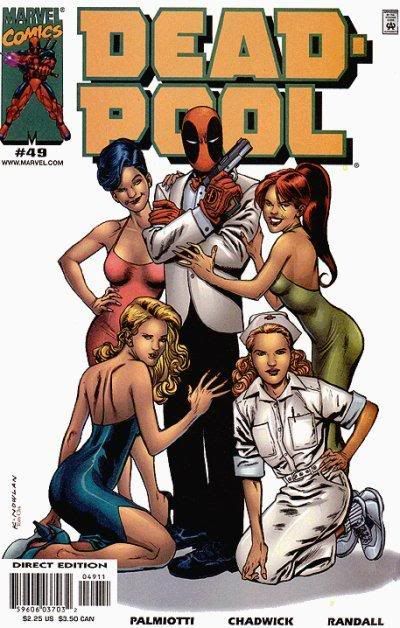
Secondly, and a bit more interestingly, it wasn’t “Deadpool” enough.  Really?  Precisely how was this movie supposed to be “more Deadpool”?  Deadpool isn’t just a schizophrenic character; his storylines are just as insane as he is.  So which Deadpool did you want to see?  There’s the Circle of Blood version.  Maybe people wanted the Joe Kelly version, that strives to be a hero but keeps getting dragged back into the mud and the blood.  The guy that sort of embraced his inner mercenary a bit more under Jimmy Palmiotti’s pen is a fun read.  Perhaps we were hoping for someone a little more quirky like the chap we met in Cable & Deadpool? 

Then there is Daniel Ways current run and I don’t even know how to describe it.  That’s done everything from having his body share a soul to having him get married to a demonic queen to having him going banana’s because he gets to kill a bunch of dracula’s.  Oh and let’s not forget the mini-series’ and one shots out there.  One of my favorite reads is honestly the Merc with a Mouth maxi-series.  So it’s not that the character wasn’t Deadpool enough, truthfully, it is more likely that you simply prefer a different iteration of the character.  The Deadpool we got drew heavily from elements of Circle of Blood (his first mini-series), Joe Kelly and Palmiotti’s runs.  And one of the reasons this might not seem as familiar to some folks is because they haven’t actually read those issues for a good decade or so (insert gratuitous ad for Deadpool Classics here)

Now let’s talk about something far more important than just invalidating a few complaints, and that’s just how much this film got right.  The film has done spectacularly at the box office and there are a lot of reasons why.  The biggest fear now is that the people who cut checks to make movies are going to learn the wrong lesson.  They’ll say it’s okay to make movies about “heroes” that bang hookers, cuss a lot, and they can show boobs and other naughty bits and they’ll make money.  None of that is why Deadpool is the financial success that it has become. 

Deadpool is doing so well for a lot of reasons.  The first one is it was made by fans for fans.  They didn’t cut corners or try and water it down so that it would be more easily understood by the “general audience”.  They adapted the film to work within the universe and budget available but they didn’t change anything about the character himself.  They did a good job of blending together a version of Deadpool that stayed within the lines for every version that has been written over the last 20 or so years.  If there is one lesson that should be taken from this movie it’s that there is a reason fans are fans and if you tell a good story that is true to the character the fans have supported for years then you will likely have a good movie that makes a lot of money (take note Michael Bay and Transformers producers it is possible to have a visually enjoyable film that makes money that has a story worth following).

The second is that it was fresh.  This wasn’t just another super hero movie.  This falls squarely in the genre of action/comedy/romance/horror.  It isn’t just one type of movie it’s all of them blended together, and blended together well.  And what’s more is that it at no point apologized for what it was, rather the film reveled in the fact that it wasn’t really that easy to define.  It doesn’t take itself so seriously that it’s not fun anymore but at the same time they take themselves seriously enough to ensure the story they are telling is worth seeing.  Honestly in some ways the film is daring you not to like it because if you don’t like it then clearly it wasn’t a film that was made for you so shut it.  If you don’t like Deadpool, you will hate this film and that’s okay, go watch something else.
Now let’s talk about something else they got correct, the characters.  The relationship between Blind Al and Wade was pretty accurate.  They made it a lot less creepy by having her be his roommate instead of his captive, and the ways he tortured here were also less creepy than locking her in a box surrounded by things that she would run into that would hurt her.  Deep down they do love each other and they seriously show that by screwing with each other as much as they possibly can.  From making the blind lady build the furniture to constantly insulting him, the relational dynamic was accurate.  Weasel was a bit more off base than Al was.  They combined him with another character named Patch so that he ran the bar and was Wade’s best friend instead of just he was a gadget geek and was Wade’s best friend.  A change made for the sake of the story that worked because while they shifted the setting of the character, they didn’t really change who he was. 
But what about Vanessa, she’s not even a mutant in this movie, and she’s supposed to be copycat!  Yeah yeah yeah, I know.  But how sure are we that she isn’t a mutant?  She even acknowledged that she’s played many roles, what’s to say she wasn’t playing one that she just found herself really liking there?  However, that’s not the key to making her character work, and it works great in this film.  The key is that her crazy matches Wade’s crazy.  I know, line from the film, but it’s the best way to describe their relationship, she’s not Syren, the gal wade is hoping to be worthy of, she’s not Domino, and she’s not any of the other gals that have gone through Wade’s life.  She’s the bad penny that always turns up and that is perfectly matched because she’s just as unstable as Wilson, just like in the film they complement each other almost perfectly. 

A lot of the others are in here too.  Francis is a one dimensional sadistic bad guy that hates his name and Wade: check.  Colossus is a gigantic Russian stereotype: Check.  Bob is a friend of Wade’s that he beats the tar out of: Check.  If you read the comics these are all really pretty accurate portrayals of who the characters are at their core.  Change the settings but as long as that doesn’t change then I’m calling it a successful adaptation.  Is anyone really upset that Negasonic Teenage Warhead had way cooler powers in this than she does in the comic? 

And then there is Deadpool.  So what are the defining characteristics of Deadpool.  He knows he’s a fictional character and breaks the fourth wall, yeah in spades.  He does not shut up.  Nailed it.  Anyone complaining because there were too many jokes and some of them weren’t really that funny has clearly never read a Deadpool comic because seriously I get tired of reading them sometimes because there is so much dialogue because Wade just never shuts up. 
He’s a badass.  Oh yeah, even the people like Taskmaster that hate him have to admit that he really is just that good, he just goes about being that awesome in a manner that is befitting a perfect idiot.  He’s not really a villain or a hero.  Much like wreck-it-ralph, he’s a bad guy but that doesn’t mean he’s a bad guy.  I’ll trust you to insert the correct inflections there, but he really does have a soft spot and tries to help folks out, he just does so with extreme prejudice at times.  And honestly, I think that sums up the character pretty well and is why this film works.  They let Deadpool be Deadpool and for the folks that didn’t like it that was their problem.

Last thing I want to acknowledge real quick, and that is the marketing on this film.  This was brilliantly marketed.  From the comic-con introduction to the red band trailer, to the Christmas ad this movie was promising great things.  It released two of the best videos on checking for cancer I’ve seen, informative and entertaining.  The spoofing of other movies, like Green Lantern and the various other banner ads that popped up just kept driving home exactly what this movie was, a serious love story that probably shouldn’t be taken seriously.  Even without action figures thanks to the ongoing feud between Fox and Marvel this movie was on point with its marketing strategy.  It might help that I think Ryan Reynolds walked away with a suit and was just having a lot of fun.  So take heart true believers, there are writers and producers out there that are actually fans of this stuff and they know how to tell a good story using these characters, that won’t sacrifice for runtime, for fear of not being understandable, or relatable and will instead just be a great movie that doesn’t care if some people don’t get it.   

Friday, October 30, 2015

Happy Halloween!

I love Halloween.  It’s just a fun holiday.  Yes I know I know, mostly based on pagan culture (like half our Christmas traditions), the night the veil between this world and the next is the thinnest and all that jazz. 
 But despite all of that, Halloween means people get to dress up in costumes.  The candy was always nice and such but the costumed fun was what made Halloween for me.

That shouldn’t come as a surprise to anyone, I’m a member of the 501st Legion after all.  But the truth is, in some ways, Halloween is the day we can be a little bit more honest with our costumes.  Costuming has been taken from the realm of kids play and fetishism into the realm of art over the last decade.  It can serve a variety of purposes.  Some do it to show off the hard work they put into themselves with the way they shape their bodies to fit a role.  For some, it’s a means to an end.  If they want to learn a new skillset but need a project to work on to learn it, enter the costume.  

But as with most art, one of the things that costuming does is communicate a message.  That message can be as simple as “I love Batman” but it’s still a message that’s being broadcast.  However, are we not wearing a costume every day in some fashion or other?  It’s not an unheard of idea, “Dress for the job you want, not the job you have” is a basic concept in the business world.

Perhaps less consciously in our adult lives, but we are in a costume every day.  When we wake up in the morning, and pick an outfit we are presenting an image of ourselves.  This is mitigated to a degree by everything from budgets to dress codes, but the we are still sending a message when we are getting ready to go, even if that message is “I stayed up to late last night and didn’t have time to care what I looked like today (my wrinkled shirts for instance).”

As we’re growing up, this might be a bit more consciously done.  We wear the bands we listen to and try to put forth an image of who we believe ourselves to be.  Always one to tilt with windmills, I was a metal head who would wear the shirts with snakes, chains, and gore to try and show people that a persons musical preference didn’t tell you anything about their intellect (I was always a good little nerd) or personality (I was the nice guy that just wanted to be liked).  

I dressed to try and show the turmoil that exists when we are growing up, but embedded within the image I was presenting were promises of hope for those willing to take a real look at me.  The best example is in one of my favorite t-shirts, and the only one I’ve ever purchased more than once.  The Tourniquet: Stop The Bleeding shirt was designed to look scary.  The snake on it certainly frightened me a bit.  But the chains surrounding the snake were there extending from the cybernetic hands of the Tourniquet logo, an intentional image they crafted to show that Satan is vicious and frightening but is ultimately under God’s control.

Perhaps I was a strange kid, it came from the role models I chose (with parental guidance admittedly steering me) who took great pains in making sure the messages they were creating were conveying the messages they wanted them to.  Bands like Tourniquet who would take the time to talk with you about what they were hoping to say and teach you to look at things that way.  It’s also part of how God wired this brain of mine.  I wasn’t a media major for no reason; that really is a part of how I think. 

In my experience with the 501st, different costumes tend to resonate more with different people.  Royal Guards tend to have similar core values and personalities for instance.  For me at least, this is one of the things about costuming that is particularly freeing.  We can wear the people we are, or perhaps the people we want to be, for a time.  If you want to be a wise cracking ninja put on the Deadpool gear.  If you want to show an indomitable spirit that doesn’t break even when most people would, put on the bat suit.  If you want to be a pretty princess (like my niece this year) then for this one day it’s totally okay to dress like one in public. 

Why do the costumes and characters that resonate with us resonate with us?  Why do some people prefer Superman to Batman, Marvel to DC, Star Trek to Star Wars?  What is it about the stories and characters, the music and movies that we resonate with and what does that say about us?  What parts of ourselves do we broadcast to others by the costumes we wear everyday, and the ones we wear when we are given permission to let loose? 

True, there is art for the sake of art, and costumes are no exception to this rule.  But I tend to think that we are normally doing more than that most of the time.  Maybe that’s because I’m writing this dressed like Charlie Brown right now.  But what does your costume say about you?  Does it tell us about who you are beneath the skin?  Maybe who you want to be?  Are you the Hulk because you want to be strong, or because you fear the angry monster within?  The way we dress is often the first message we communicate to people, what are you saying?

Wednesday, September 23, 2015

Foolishness to Greeks: Judgment

Alright, before starting, again I want to state, this is a blog post.  It is about 2 – 3 pages long.  This is not a comprehensive work, and it should not be treated as such.  I am simply hoping to try and help clear up some of the things, both for believers and non-believers alike, that are not necessarily understood due to misunderstandings of language and practice.  Because there are some very real differences between our worldviews and these have lead to a large amount of incivility of late.  The idea that I am looking at this go around is something that has been talked about a lot over the last decade or so, judgment. 


“Christians are so judgmental.”  Bypassing the delightful irony of the condemning tone people use when they say this, judging those they deem judgmental.  Many would direct us to Matthew 7:1, quoting “judge not” out of context.  However, people make judgments every day; we cannot function as a society without making a judgment actually.  We are not truly being condemned for judging in these instances, but rather we are judged for judging “incorrectly” by today’s standards.  


To declare an action wrong is an affront to the modern god we have erected named Tolerance.  We will sacrifice dignity, intelligence, and sanity lest we ourselves be judged intolerant.  If you would like a fantastically satirical example of this, I suggest watching South Park’s “DeathCamp of Tolerance” episode, but be warned, it is incredibly offensive.  Not only do we insult the modern ideal of tolerance by declaring something wrong, but we also find ourselves running up against the modern relativistic philosophical conceptions of truth and reality, and here I believe is where we find ourselves at a disconnect with the world we now live in.


But before we tackle the differences in worldview, let us examine how we as Christians tend to exacerbate these misunderstandings.  The first is the idea that by judging an action wrong we are condemning not only the action, but also the person.  This is inaccurate, but it is easy to understand how the conclusion is reached.  To begin, judging an action made by a person, and judging a person, are fundamentally different things.  That seems to be something that we forget.  If a person declares that something is a sin, or morally wrong, they are judging an action, not the person committing the action.  Sadly, people fail to stop at that point and rather than simply declare that an action is wrong they change the focus of the conversation to the person committing the action.


This just is not a good way to make friends and influence people.  And a huge part of this is connected to our beliefs about human nature, and how badly flawed these have become.  When we declare an action sin, people think we are condemning them for that action.  Biblically speaking we were all condemned well before whatever action we are discussing took place.  What the world hears us saying is that the action that we are condemning condemns them.  It would be more accurate to say that a person commits an immoral action as proof that they were already condemned.  (Investigate the doctrine of Total Depravity to start)


This is an important distinction.  Biblically, all persons are born under a curse (see Genesis 3).  Everyone is equally damned from square one.  People are not pure beings made impure solely by a specific action.  People are impure beings, whose actions will reflect that impurity.  Christians are no different.  They are impure people who have been made pure through the blood of Jesus.  A lot of the misunderstandings that exist out there exist partly because Christians in their pharisaical piety have forgotten this.


Sadly, we fail to recognize the reality that we are no different from the person whose actions we are standing against.  All have sinned according to Romans 3:23, and the wages of that for all persons is death according to Romans 6:23.  Within a Biblical framework, we are all in the same boat and it is sinking.  Christians are just the ones that grabbed the life vest we were offered that we did not pack on our own.  Telling someone they are going to drown if they refuse help and try to swim it on their own may not be what the other person wants to hear.  But what is more loving, to tell them something they do not want to hear in the hope they will not drown, or to let them drown and just float on by?


Now, so far we have basically looked at how Christians do a bad job through losing focus, and perspective.  Some of this is just bad marketing and frankly Christians seem to be terrible when it comes to any sort of PR.  But it is not all a matter of bad PR.  Beyond the simple difference of belief regarding human nature, there are some serious points of disconnect in our worldviews that we are running up against.  This is the difference between relativistic morality and absolute morality.  It is very popular today to pick and choose what we want from the Bible.  This seems to be most readily discussed and demonstrated in the way we ignore the rules set in place regarding sexual morality (in general) on a regular basis.


Within moral relativism, we have no real standard.  The consensus would seem to be “everyone has a right to their happiness”.  There are no legitimate grounds to call an action good or bad, right or wrong, just or unjust within this framework.  These concepts become completely arbitrary.  We cannot defer to democracy to save us, there have been plenty of times when a majority have been morally wrong.  To see this, we need look no further than Jim Crow laws.  What about determining what is right for you, as an individual based on your own philosophy?  This is basically the definition of an ethical sociopath.


What about love, does that then become our standard?  After all, there are some who will say that the Bible is primarily teaching us to love.  The second greatest commandment is to love our neighbor as ourselves.  But then who is to decide what a loving action is and is not?  Does love not have restrictions placed upon it?  It most certainly does.  No loving parent will let their child put a key in an outlet, they will run toward them yelling “no”, fearing what harm might come to the child.  Love puts restrictions on people, for their own good.  So then who determines what those restrictions should be?  Instead of love, do we defer to whatever makes a person happy, as long as it does no harm to another?  We have already defeated that very notion by putting a restriction on people.  What if what makes someone happy does cause harm to another?  Do they not still have a right to their happiness in a relativistic framework?


Without an absolute standard of right and wrong, the very concepts are meaningless.  So we must have an absolute standard.  For a Christian, this begins and ends with the Bible.  Yes, this does take the approach of Biblical Inerrancy.  Yes, I do understand this is an approach to the Bible and not one that is shared by all who claim the title Christian.  However, as previously demonstrated, once we start picking and choosing what we will and will not use, we essentially defeat the entire concept of morality.  For if God is not to be taken at his word, and remains a mutable being, then we have no legitimate basis for declaring anything right or wrong.


Moreover, when we start to tear passages out of the Bible, further questions must then be answered.  If we ignore this moral rule, then why do we need to be saved?  What is sin if we are not going to pay attention to what the Bible says about how to live a good life and only give credence to the pleasant spiritual lessons?  Why did we need to be saved if there was no sin?  What was the entire point of Christ’s sacrifice?  If Christ was not who he claimed to be, then why should his example be followed?  The entire thing becomes a house of cards when we start to simply pick and choose without Scriptural justification.


Some will readily point out the supposed hypocrisy that Christians do not apply Levitical law to everything, only what they deem offensive.  That Christians are applying Levitical law to anything is incorrect actually.  Levitical law should only apply under the New Covenant to flesh out the guidelines laid down in the New Covenant.  Christians are explicitly told they do not need to become Jews, and many of these laws exist solely to create a Jewish cultural identity, setting them apart from the rest of the world.  But not all of the rules given in Leviticus were specific to a Hebrew culture, and these are again referenced under the New Covenant.  Indeed, sexual immorality of any sort is one of the things readily written against in the New Testament (again referenced as this seems to be an area we are quick to let lapse).


Under a paradigm where God is the judge of what is right and wrong and has handed us instructions on how to best live our lives in fellowship with Him and with our fellow man, Christians are not actually able to make a moral judgment.  The ability to determine, or to pretend to determine, right and wrong for ourselves is one of the things we abdicate.  This is because God is the judge, not us.  Christians should not be pointing out lapses in others as if they were the law.  We ought to be pointing them out as children telling someone something is a no-no.  The entire purpose of a Biblical Christian making a moral stand, saying that anything is wrong, is to help people realize they need a Savior just as badly as we do.


“Judge not” is a misquote.  The Bible does not teach us not to judge, that would mean we fail to use rational discernment in our day to day lives.  Rather it teaches us that we are not the judge.  An action has already been judged as right or wrong by a God who is just.  It is not our place to argue with that judgment.  Recognizing when a rule has been broken is seldom a judgment call, a rule was either broken or it was not.  There are grey areas, I grant this, there are things that people will avoid so that they do not present an appearance of evil.  But the rules that are laid out regarding many of topics of morality, such as fornication and adultery actually have pretty simple lines.  It just does not seem as fun to stay within them so we readily will leap across to the other side and then rather than admit we did something we should not have done, we instead stand firm in our folly and try to justify our decisions.


We are not to leap to judge others, removing the speck from their eye while beating them to death with the plank in our own.  We are to judge ourselves first, and the stick we use to measure ourselves ought to be, if anything, harsher than the one we use to examine others.  We ought to point out a moral lapse, not because something offends us, but only because we are trying to help people reach the point where they are willing to offer the help they are offered through Christ.  And this only after examining ourselves, prayer, and with solid Biblical support.  If you try to take a stand against something as wrong because it offends you rather than on solid Biblical grounds, you will likely find yourself planting your feet in quicksand.


Everyone had had a moral lapse, everyone will have one again, and again and again.  We are not being good Christian soldiers when we jump on them for falling.  Does approaching someone as if to say “see what a bad person you are” help anyone seek Christ?   When we see someone who is mired in a lapse of morality, we ought to examine our own heart, and then offer a hand out in help, telling people that it is okay they fell into a trap, because so do we, and God pulled us out of that one too.  If we were to be really honest, the only reason we might recognize the trap our brother is in is because we were there not too very long ago.

Sunday, August 9, 2015

Foolishness to Greeks: Repentance


One thing that has been brought to light to me recently is a better picture of the extent to which Christians no longer make sense in society.  This wasn’t always the case, but within the last generation we have shifted away from a society rooted in Christendom and toward a Secular society.  There are a lot of consequences from this shift and I haven’t the time, space, or interest in unpacking all of those here.  However, one of those is that Christians continue to use terms and language that people do not understand.  

So, in an attempt at foreign relations, a task which I am immensely under qualified to perform (as I am not a scholar in Greek or Hebrew nor am I a linguist), I want to try and unpack some of the terms that seem a bit contentious.  To begin, I’d like to look at the idea of repentance.  Repentance has come to be understood as equivalent with an apology.  The term apology is defined as synonymous with regret, confession, admission of guilt, request for forgiveness, act of contrition, and expression of regret.  The term repentance, however, is synonymous with regret, sorrow, remorse, penitence, atonement, shame, contrition, and penance.

The dictionary doesn’t even define these things as being equivalent to one another, rather this is a cultural misunderstanding.  A part of this misunderstanding may be in the common language that both use to express themselves.  When we are apologizing we say “I’m sorry”.  This is a part of what is done when a person repents.  We have to ask forgiveness from those we have wronged when we repent.

However, when a Christian speaks of repentance it is not simply a matter of “saying I’m sorry to their imaginary friend in the sky.”  It’s also not as simple as just saying I’m sorry (and saying this to the person that was wronged, not a third party).  Repentance is predicated upon the recognition of wrong doing, and therein lays the largest distinction between the two ideas.  We apologize all the time, but we do not always admit we have done something wrong when we do so, and we certainly don't always make a change to ourselves.  It seems “I’m sorry” a lot of the time not for an action we have taken, but rather we are sorry for the reaction that was caused by our action.  

In Hebrew, there are multiple words that are translated repent. שׁוּב shuwb {shoob} is one (Ezekiel 14:6).  It means to turn back, or to return.  It does not always connect to the idea of returning to a starting point.  In some ways this might be a good thing to note.  From some actions, even if a person acknowledges wrong doing, they will have burned bridges that are not able to be repaired. נָחַם nacham {naw-kham'} is another. This is connected to the idea of sorrow, grief, but also to the idea of comfort.  A strange connection perhaps, but admitting we are in the wrong and wish to cease this, while it may be painful to go through is necessary if propitiation is ever to be reached.

This point is driven home in 2 Corinthians 7:9, 10:

As it is, I rejoice, not because you were grieved, 
but because you were grieved into repenting. 
For you felt a godly grief, so that you suffered no loss through us.
10 For godly grief produces a repentance that leads to salvation 
without regret, whereas worldly grief produces death.

The Greek word for repentance used here is μετάνοιαν.  Its root is μετάνοια metanoia {met-an'-oy-ah}.  This is a change of mind.  Taken subjectively this is a compunction that drives one to reformation, and by implication is a reversal. 

So, I hope that helps clear up what repentance means in the Biblical sense.  This is no simple apology, this is declaring that we are in the wrong without excuse or exemption.  Admitting our wrongdoing to the party we have wronged is a part of this.  But we must also turn our backs on our wrong doing.  We can't persist in wrongdoing, that is not repentance.  Repentance demands actions on our part.  Not all bridges can be rebuilt.  Some trusts may never be restored and some fences may never be mended, even if a person forgives someone for wronging them.  But if we don't repent, and meld our apology with our actions; we can't even begin to try.

Sunday, May 3, 2015

Why nerd girls, and others, get asked to "prove it"

Greetings everyone.

Well, after a lot of time, I think I'm going to weigh in on a couple things here.  The first is a divide between nerd groups today, and the second is some of the perceived discrimination that nerd girls experience.  The reason I'm addressing both of these at the same time is honestly I think they are connected at the source.

I think that the source of these issues is, simply put, an issue of trust.  Until the last roughly 5, maybe up to 10 years, it wasn't cool to be a nerd.  Admitting that you liked comic books, going to any sort of pop culture convention, watching Star Trek, reading Star Wars novels, and wearing costumes in particular were signs that you were a social pariah.

We were mocked, some going so far as to consider us unintelligent, with questionable morality.  We were ridiculed for being immature because of the media we consumed and the way we consumed it.  We struggled to make friends and only found acceptance with our fellow nerds.  It's one of the reasons why some of this has changed, but look at how the "popular" and "normal" people talk about the "nerds" on a show like Big Bang Theory.  While some of the stigma is gone, the overall tone remains one of derision.

A lot of us that are now adults still carry the scars we got growing up a nerd.  And some of those scars go a lot deeper than one might suspect.  Being a nerd, in a lot of ways, became a part of your identity.  It was something that we had to learn to accept.  Some of us embraced it regardless of the scorn it brought us.  It was the thing that we felt made us unique, and it was also the thing that we felt forced us to be alone.  I know that might sound a little melodramatic, but it's actually very true.

Though the next bit of this is anecdotal, I strongly suspect it is something that many others can relate to.  In my own family, my enjoyment of action figures and collecting is still considered a sign of immaturity.  When I initially decided to join the 501st Legion, my family thought I'd lost my mind.  To this day, when people find out that I wear a Star Wars costume, the eye rolls are easily predictable.  That I do so primarily for children's charity events does nothing to mitigate the perception that I must clearly be immature and a bit out of touch with reality. 

This is now, in an age when being a nerd is considered somewhat cool.  This is at the crest of the convention and cosplay boom.  When the top grossing films for the last several years are all rooted in the comic books I anticipated ridicule for reading, one would expect that the stigmatization would've lessened some. 

But old wounds heal slowly.  Now, we're expecting the other shoe to drop.  We see people who have never read a comic book talking about the characters we were teased for enjoying.  We see our subculture being co-opted by the jocks that would bully us.  There exists a divide between fans of comic book movies and fans of comic books today.  And a big part of that divide is caused by a lack of trust.

We are waiting for the next big thing to come along so that we can find ourselves the subject of one big societal prank.  And the reason is because it wouldn't be the first time.  This is why those of us who had to live with the discrimination, who had to put up with society mocking us until technology finally caught up to our imaginations enough that we were able to let people see what we had really been enjoying all along, this is why we have a hard time with those who didn't earn their stripes.  There's a part of us that doesn't trust them to really be our friends. 

Theoretically, this is also why "nerdgirls" have to prove it.  Nerds were never popular.  Girls wouldn't give us the time of day.  Watch any show starring nerds and see how fast you lose track of the number of "virgin" jokes that get made.  Far too many of us have stories about that pretty girl we liked who would only pretend to think we were worth talking to when they were getting help with their homework.  Some of us knew when we were getting played, but we didn't care because at least there was a girl paying attention to us for a little bit. 

So when a pretty woman starts talking about being a nerd, this is why the response is "prove it".  It's not because we want to be sexist or discriminatory.  But we developed a defense mechanism that doesn't let us get our hopes up that we might actually be able to connect, on any level with a woman.  (No, I'm not going to go into the idea that we are only interested in connecting physically here, that's a whole other series of conversations.)  In typical nerd fashion, we don't necessarily manage to communicate well.  It's not that we need to see someone prove they are legitimately nerds.  We want to know if we can actually trust them.

We want to know if this is a safe person.  We want to know if we can honestly be ourselves around them without worrying about being judged or mocked.  We want to know if we've actually found someone it's okay to try and connect with regarding something that really is a core/defining part of our identity.  I'm not saying it's right, but I also think that the divide between old school nerds and new wave nerds, and the distrust of the opposite sex when it comes to this topic is perhaps a bit more understandable.  


Monday, March 9, 2015

A Good Friend has Passed Away

So, I'm not really certain what I'm supposed to do right now.  Today we found out that a good friend of mine passed away Saturday evening.  What do you do when someone suddenly isn't there.  You don't have much choice but to go on living.  It feels like everything should be changed now, but it's not, and that seems really just as strange as the thought that he's gone.

Brad Wright was a good friend.  He was that guy that everyone who met him was glad to have had that chance.  There was a core joy to him, even when he was extremely frustrated, he was still able to laugh and make others laugh.  He had experienced the sort of pain I never would wish on anyone, losing a child when he was very young, and yet he didn't grow bitter because of that pain.  Brad was the guy you could count on in any sort of pinch.  A lot of the time, Brad didn't seem to have enough money to splurge on himself, but he always had enough to help other people.  He would just randomly pick up someone's check from time to time because he felt like being nice or helping out. 

He grew up in New York, and had some very interesting insights that he shared from those experiences.  He was a veteran, having served in the USAF.  The best story I ever heard him tell about his time in the service involved him tanning.  He would go out to the pool every day to read, and everyday some lady would keep complaining about him being in her spot.  Well evidently he got tired of this and so one day he went out and bought some white body paint, or something similar and put that on under his swim suit.  When she came up and started complaining he told her that he was out there tanning too because he was as pale as her when he started.  She didn't believe him so he pulled down part of his bathing suit to show her and evidently she ran away in shock.  On the other hand, he didn't get hassled for having her spot at the pool anymore.

Brad was also my convention travel companion.  I've roomed with him for almost every convention I've gone to in Dallas the last few years.  We'd drive down and both have fun, we were actually talking about making the trip for Fandays in October this year on Saturday, I wish I would've known that was going to be our last conversation.  One thing to know about rooming with Brad though, he snored.  And I don't me he made some noise.  I mean it sounded like a jet engine being powered by a chainsaw that was manned by a rabid badger had been shoved up his nose.  I almost never got any sleep the first night of a convention, and then by the second night I was tired enough to just sleep through the noise. 

He was nice always nice enough to help me out with photos at conventions.  Though he was a bit camera shy himself.  He also was always happy to just stand in line and hang while we were waiting for autographs.  (It's thanks to him that I have a great Huntress sketch by Amanda Connor).  He also was my contact for fundraising that we did with the Children's Miracle Network a couple of years.  He was a part of the group that I game with on Saturday nights, and one of my poker buddies for whenever we would get together for a night of cards.  Brad had a special knack for waking up just in time to roll his dice and do something amazing.  Once he rolled a Natural 1 and rather than cause a problem he successfully took out every enemy in the room. 

I'm not sure what more to say here.  Brad was my friend, and I am going to miss his kind heart and good nature.  I don't know how better to honor him, but I hope to find a way.  You will be missed my friend, may you rest in peace.

Sunday, February 15, 2015

Why I still love Masters of the Universe

So, lately I have been on this gigantic Masters of the Universe kick.  I enjoyed He-Man and She-Ra growing up.  I never really saw the New Adventures of He-man when it came out, but I was able to watch it on YouTube not too long ago and quite enjoyed it.  When I got into college I loved the Mike Young Productions series.  A friend of mine called it an example of what American Anime was capable of at its best.  I agree with him on that to this day, the animation holds up and is absolutely gorgeous.  I've fluctuated a bit with how the comics have been handled since they came out, but overall I have enjoyed them, The Eternity War series has loads of potential that I can't wait to see explored. 

Starting with the 200x series, I also started to appreciate the sculpting and artistry of converting an animated character into an action figure.  With the Masters of the Universe Classics series, my appreciation for this has grown tremendously.  These action figures are gorgeous.  They really are works of art, and the story that has been built for these characters using their biographies is one I have found myself enjoying quite a bit.

But it's not the cartoons or the action figures that I think has me loving this series so much at this juncture.  Rather, I believe it's the two dominant concepts that the series consistently presents that I am still enjoying.  The first one is the idea in the title, Masters of the Universe.  The characters each act as epitome's have achieved mastery over something.  He-Man is the strongest man in the universe.  Beastman has mastery over beasts, Tri-clops over vision etc.  True the naming scheme is fairly simplistic a lot of the time, but it is a fun idea and employs a system of checks and balances that is a lot of fun from a story creation stand point (hey I did grow up playing with these characters after all).

But even more simplistic than the naming scheme of the characters is I think why I enjoy the series the most.  The good guys are good, and the bad guys are bad.  The villains have depth to them, the idea that Skeletor is actually the rightful heir to the throne of Eternia is really enjoyable.  I love that we are seeing a family at war with itself as it adds a bit of personal interest to each engagement.  But at the same time, the villains remain villainous and the heroes heroic. 

We live in a world that seems to celebrate the grey areas of life.  We can no longer trust our leaders and the sources of information we have available to us seem less and less reliable.  Having a moral stance against anything is no longer acceptable, and adhering to certain standards casts us as elitist or oppressive.  We live in a world where we practically can't do anything without someone being offended or somehow socially irresponsible, and in this world, the lines between good and bad, light and dark, are often blurred.  We've taken the Star Wars approach of everything depending on a certain point of view to preposterous levels.  Forget about confusing, it's exhausting.

I think that's what I enjoy the most about this series, is the simple demonstrations of good and evil.  True, the good guys will team up with the villains to fight a greater threat, but at the end of the day the lines aren't crossed.  The villains come in various shapes and sizes.  The Evil Warriors, the Horde, the Snake-Men, none really likes the others, evil takes many forms in the universe.  Heroes may abandon their principles and become villains (Snake Man-at-Arms), while villains may choose to reject who they had been and become heroes (Force Captain Adora).  But a hero does what is right while a villain does not.  A hero looks out for others, a villain only for themselves.  A hero plays the long game, a villain looks at the short reward.

In the real world, doing the right thing can get messy.  Even knowing what the right thing to do is sometimes can become complicated.  We are all fallen and we are all going to mess up.  But simply screwing up is not the same thing as switching sides.  When we are redeemed, we are given a new nature.  We wage an internal war that actually might well resemble the struggles of these characters.  But at the same time, no matter how complicated things become, there remains a line.  One of the truths that we are given in the Bible is that "If a house is divided against itself, that house cannot stand." (Mark 3:25)  We can't be both hero and villain, we ultimately will have to choose.  While the Masters of the Universe is not real, like all mythology it gives us a chance to experience the complex realities we are surrounded with in a way that gives us the opportunity to process the things we are grappling with.